
My sister called me six days after our mother died and asked me not to touch the house.
Not the furniture.
Not the boxes in the attic.
Not even the chipped yellow dishes Mom had been threatening to replace since the first Bush administration.
“Just leave everything where it is until I get there,” Laura said. “Please.”
I was standing in Mom’s kitchen with one hand wrapped around a mug of coffee I had already reheated twice. Through the window above the sink, I could see Mr. Donnelly next door dragging his trash cans back from the curb. The maple tree my father planted when Laura was born had dropped wet red leaves across half the driveway.
“Laura, you’re not coming for another three weeks.”
“I know.”
“The refrigerator has food in it.”
“Obviously throw away the food, Megan.”
“And the broken pipe?”
She went quiet.
That was the reason I was there in the first place.
A pipe behind the downstairs bathroom had started leaking two days after the funeral. By the time I noticed, water had soaked through part of the hallway wall and warped several boards near the pantry.
The plumber had already told me the wall needed to be opened.
“Fix what you have to fix,” Laura said finally. “Just don’t start going through Mom’s things without me.”
“I wasn’t planning to.”
Another pause.
Then she said something strange.
“Especially the pantry.”
I looked toward it.
Mom’s pantry was hardly a treasure vault. It was a narrow room with five shelves, a broom, enough canned tomatoes to survive a small war, and a plastic bag filled with other plastic bags because our mother considered throwing away a usable grocery bag a personal failure.
“The pantry?”
“I just mean don’t start tearing things apart.”
“I’m not tearing anything apart. A contractor is coming tomorrow.”
Laura exhaled.
“Megan, promise me.”
There was an urgency in her voice that didn’t belong to canned tomatoes or drywall.
I put my coffee down.
“What’s in the pantry?”
“Nothing.”
She answered so quickly that I almost smiled.
Almost.
“Then why are you worried about it?”
“I’m not worried.”
“You called from twelve hundred miles away to tell me not to touch a room containing expired soup.”
“Can you please just do this?”
I looked at the pantry door.
My sister and I had spent most of the previous week making decisions nobody wants to make. Flowers. Hymns. Which photograph of Mom should sit beside the guest book. Whether she would have hated the navy dress the funeral home suggested.
I didn’t have the energy for another argument.
“Fine,” I said. “I’ll leave it alone.”
“Thank you.”
Then, before hanging up, Laura added:
“And Megan?”
“What?”
“If you find anything unusual, call me before you call anyone else.”
That time, I didn’t answer.
My mother, Evelyn Hart, had lived in that house for forty-one years.
My father bought it in 1985, when I was seven and Laura was four. Back then it had brown carpet, avocado appliances, and wallpaper covered in tiny blue flowers. Dad spent the next decade slowly removing all three, usually while swearing at whichever tool he’d bought specifically for the job.
He died when I was twenty-nine.
Mom stayed.
She said moving would require deciding what to do with forty years of belongings, and she’d rather die.
At seventy-eight, she got her wish.
A stroke took her on a Sunday morning while she was watering the African violets in the sunroom.
There was no long illness. No hospital bed in the living room. No gradual preparation.
On Saturday she’d called me to complain that the grocery store had stopped carrying her favorite marmalade.
By Sunday afternoon, I was choosing a funeral home.
Laura flew in from Denver that night.
For five days we functioned surprisingly well together.
She handled phone calls because she was better at sounding composed. I handled paperwork because numbers made her impatient. We chose the casket together, wrote the obituary together, and stood beside each other while people we hadn’t seen in twenty years told us how much we resembled our mother.
Then, the morning after the funeral, Laura left.
Her husband had called about their youngest son, who had broken his wrist at soccer practice.
She promised she’d return as soon as she could.
I believed her.
I also believed her when she said we would sort through Mom’s things together.
Until she mentioned the pantry.
The contractor arrived the next morning at eight fifteen.
His name was Owen Price, and he had repaired Mom’s porch railing two summers earlier. He was in his late forties, broad-shouldered, quiet, and carried a pencil behind his ear that I never actually saw him use.
He examined the water damage, disappeared into the basement, came back upstairs, and spent several minutes tapping the wall beside the pantry.
“How bad?” I asked.
“Could be worse.”
Whenever a contractor says that, I’ve learned it means the bill will hurt but probably won’t require selling a kidney.
He pointed toward the baseboard.
“Pipe runs behind here. I’ll need to open this section.”
“How much of it?”
“Maybe three feet.”
I thought about Laura.
“Can you do it without touching the pantry?”
Owen looked at me as if I’d asked whether he could repair the wall without touching the wall.
“The pipe’s behind the pantry.”
“Of course it is.”
He waited.
I sighed.
“Do what you need to do.”
For the next hour, I sat at Mom’s dining-room table answering condolence messages while the sounds of drilling and hammering came from the kitchen.
At 9:47, the noise stopped.
I noticed because silence had become unusually noticeable in that house.
Then Owen called my name.
“Megan?”
Something in his voice made me stand.
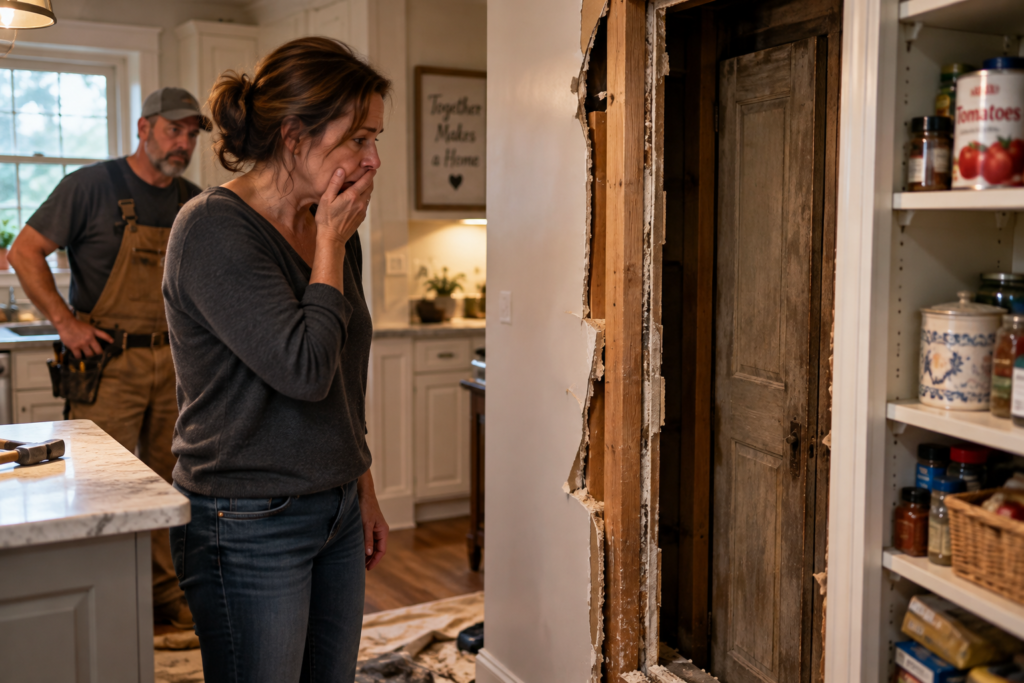
He was inside the pantry, surrounded by pieces of drywall.
“What happened?”
He didn’t answer immediately.
Instead, he pointed.
Behind the damaged wall was another wall.
Except it wasn’t a wall.
It was a narrow wooden door.
The door had been painted the same dull beige as the plaster surrounding it. No knob. No visible hinges. If the pipe hadn’t leaked, I could have emptied that pantry shelf by shelf and never known it existed.
Owen ran his fingers along one edge.
“This wasn’t part of the original wall.”
“How can you tell?”
“Different framing. Somebody built over it.”
“When?”
He shrugged. “Not recently.”
I stared at the door.
My first thought was ridiculous.
Laura knows.
My second thought was worse.
Mom knew.
“Can you open it?”
“Probably.”
I remembered my promise.
If you find anything unusual, call me before you call anyone else.
“I need a minute.”
I stepped into the hallway and called Laura.
Straight to voicemail.
I called again.
Nothing.
Then I sent:
Call me. Now.
Three dots appeared almost immediately.
Then disappeared.
A minute later, my phone rang.
“What happened?” she asked.
No hello.
No How are you?
Just:
“What happened?”
“The contractor opened the pantry wall.”
Silence.
“Laura?”
“What did he find?”
I looked through the doorway at Owen.
“A door.”
My sister didn’t speak.
That was all the confirmation I needed.
“You knew it was there.”
“Megan—”
“You knew.”
“I knew there was something behind the wall.”
“How?”
Another silence.
Then she said, “Don’t open it.”
I actually laughed.
It came out sharper than I intended.
“You’re going to have to do better than that.”
“I’ll explain when I get there.”
“You said three weeks.”
“I can get a flight tonight.”
That stopped me.
Laura hated flying. She had driven eighteen hours to our cousin’s wedding because she disliked turbulence.
Now she was willing to get on a plane the same day because I’d found a door.
“What is behind it?”
“I don’t know exactly.”
“That’s not an answer.”
“Megan, please.”
Owen pretended not to listen.
He wasn’t convincing.
I lowered my voice.
“Did Mom tell you about this?”
“Yes.”
The answer landed harder than I expected.
“When?”
“Last year.”
Last year.
Not during Mom’s final week.
Not as part of some rushed conversation.
For an entire year, my mother and sister had shared a secret about the house.
And neither of them had told me.
“Why didn’t she tell me?”
Laura’s voice softened.
“I think that’s what she was trying to figure out.”
That hurt more than if she’d simply said she didn’t know.
I looked at the hidden door.
“I’m opening it.”
“No.”
“It’s Mom’s house.”
“It’s our house now.”
“Then I own half the door.”
“Megan.”
“I’ll see you tonight.”
I hung up.
Owen didn’t ask whether I was sure.
He fetched a pry bar.
The door opened inward with a dry cracking sound, releasing air that smelled like dust, old wood, and something faintly metallic.
Behind it was a space no larger than a coat closet.
There were no skeletons.
No stacks of cash.
No secret tunnel.
Just a small metal filing cabinet, a wooden chair, and a shelf.
On the shelf sat six cardboard boxes.
Each box had a year written on it.
The handwriting was my mother’s.
I stepped inside.
“That’s weird,” Owen said.
I almost laughed again.
“Thank you, Owen.”
He understood.
“I’ll work on the bathroom.”
When he left, I crouched beside the first box.
For several seconds, I simply stared at it.
I was twenty.
Laura was seventeen.
That was the year I left for college.
It was also the year my parents nearly divorced.
At least, that was what we’d been told.
Dad spent six months sleeping in the basement. Mom stopped wearing her wedding ring. There were arguments behind closed doors and long drives nobody explained.
Then one day, everything returned to normal.
Or what passed for normal in our family.
Dad moved back upstairs.
Mom put her ring on.
Nobody ever discussed it again.
I lifted the lid.
Inside were photographs.
Dozens of them.
At first, they seemed ordinary.
Dad beside his truck.
Mom at the kitchen table.
Laura holding a birthday cake.
Me carrying boxes into my college dorm.
Then I found a photograph of a boy I’d never seen before.
He looked about twelve.
Dark hair.
Thin shoulders.
A serious expression.
He was standing beside my father.
And my father had one hand resting on his shoulder.
On the back, Mom had written:
Daniel and Robert — June 1998.
Daniel was my father’s name.
Robert was not a name I recognized.
The box contained seventeen photographs of the boy.
In some, Dad was alone with him.
In others, Mom was there too.
One showed all three of them sitting at a picnic table.
My mother looked directly at the camera.
She wasn’t smiling.
Beneath the photographs was an envelope addressed to my father.
The return address belonged to a woman named Carol Mercer in Columbus.
I knew I shouldn’t read it.
I opened it anyway.
The letter was short.
Carol thanked my father for helping with Robert’s school expenses.
She wrote that Robert was asking more questions.
She wrote that keeping “the truth” from him was becoming harder.
And at the bottom:
I know what we agreed, Daniel, but he deserves to know who his father is.
I read that sentence three times.
Then I sat down on the dusty floor.
My father had another son.
At least, that was what I thought.
For the next two hours, I went through the boxes.
The story they told was stranger than that.
The 2001 box contained copies of checks from my parents to Carol Mercer.
The 2007 box held school records and a graduation announcement.
The 2012 box contained newspaper clippings about a man named Robert Mercer who had opened an auto-repair shop outside Columbus.
In the 2019 box, I found a Christmas card.
There was Robert, older now, standing beside a woman and two little girls.
On the back, he’d written:
Evelyn, thank you for keeping your promise. I still don’t think I’m ready to meet them. Maybe someday.
Them.
Not her.
Not Megan.
Them.
Laura knew.
My hands started shaking.
I called her again.
This time she answered immediately.
“You opened it.”
“Yes.”
She sighed.
“How much did you find?”
“Enough to know Dad had a son.”
“No.”
The certainty in her voice confused me.
“What?”
“Robert wasn’t Dad’s son.”
I looked at the photographs spread around me.
“Then who was he?”
Laura was quiet for so long that I thought the call had dropped.
Finally she said:
“Mom’s.”
I stood so quickly that I hit my shoulder against the shelf.
“What did you just say?”
“Robert was Mom’s son.”
“That’s impossible.”
“It isn’t.”
“She had us.”
“Before us.”
My mind began doing arithmetic I didn’t want it to do.
Mom had been twenty-one when she married Dad.
I had been born three years later.
“How old was she?”
“Seventeen.”
I sat back down.
Laura continued carefully.
“Mom told me last year after she had that minor car accident. It scared her. She started talking about wills and things she hadn’t dealt with.”
“And she chose you.”
There it was.
The part I hated myself for caring about.
Our mother had carried this secret for sixty years.
And when she finally told one of her daughters, she chose Laura.
“I didn’t ask her to tell me.”
“But she did.”
“Yes.”
“Why not me?”
“I don’t know.”
“You said she was trying to figure it out.”
“She was.”
I picked up the Christmas card.
“Robert knows about us.”
“Yes.”
“And you know about him.”
“Yes.”
“So I’m the only person who didn’t know.”
Laura didn’t answer.
I didn’t need her to.
My mother had given birth to Robert in 1964.
Her parents sent her to live with an aunt during the pregnancy. After he was born, a couple named Mercer adopted him.
Mom returned home.
Nobody talked about it again.
Years later, after she married Dad, she told him.
Dad helped her find Robert when he turned eighteen.
Robert wanted contact, but only from a distance.
Letters.
Photographs.
Occasional updates.
No family reunion.
No surprise visits.
He had parents he loved and didn’t want to hurt.
Mom respected that.
For decades, she kept everything.
Every photograph.
Every Christmas card.
Every school announcement.
Every scrap of evidence that a boy she’d held for less than an hour had grown into a man.
“Why the hidden room?” I asked.
“Grandpa.”
“What?”
“Mom’s father.”
Laura explained that when our grandfather became ill, he moved into Mom’s house for almost a year.
He still believed Robert’s existence was a shameful family secret.
Mom had hidden the boxes behind pantry shelving so he would never find them.
After Grandpa died, she simply left them there.
Over time, Dad built the false wall properly.
A secret became part of the architecture.
That sounded exactly like my family.
Laura arrived just after eleven that night.
She came through the front door carrying a small suitcase and looking as if she’d aged five years since the funeral.
I didn’t hug her.
She noticed.
Neither of us mentioned it.
We sat in the kitchen.
The boxes were stacked between us.
“I’m sorry,” she said.
“For what?”
“Keeping it from you.”
“How long were you planning to?”
“I wasn’t.”
“That’s convenient.”
“Megan.”
“You had a year.”
“Mom asked me not to tell you.”
That stopped me.
“Why?”
Laura looked toward the pantry.
“Because of Dad.”
“Dad’s been dead seventeen years.”
“I know.”
“Then explain it.”
She reached into her purse and removed an envelope.
Unlike the others, this one wasn’t old.
My name was written across the front.
Megan.
Mom’s handwriting.
I didn’t take it.
“Where did you get that?”
“Mom gave it to me.”
“When?”
“Three months ago.”
I stared at my sister.
“She gave you a letter for me three months ago, and you didn’t give it to me?”
“She told me when.”
“When?”
Laura’s eyes filled.
“When you found the room.”
For the first time since she arrived, I didn’t know what to say.
“She knew the pipe would leak?”
Despite everything, Laura almost smiled.
“No. She knew eventually we’d sell the house or renovate it. She said secrets don’t stay behind walls forever.”
I took the envelope.
Inside were four handwritten pages.
I recognized Mom immediately in the first sentence.
Megan, if you’re reading this, you’re probably furious with your sister, so please stop glaring at her. This part was my fault.
I laughed.
Then I cried.
Sometimes grief waits for the smallest familiar thing before knocking you flat.
Mom explained Robert.
Not clinically.
Not as a confession.
As a mother.
She described being seventeen and terrified, waking in her aunt’s spare bedroom every morning with both hands over her stomach because for a few seconds she could pretend nothing had changed.
She described the hospital.
The social worker.
The blanket Robert was wrapped in.
The sound he made when a nurse carried him away.
Then she wrote something I hadn’t expected.
Your father was the first person I ever told voluntarily.
Dad hadn’t been angry.
He hadn’t judged her.
He’d asked one question:
“Do you want to know if he’s okay?”
Years later, he helped her find out.
That was why he appeared in the photographs.
That was why he sent checks.
Not because Robert was his son.
Because Mom loved him.
And Dad loved Mom.
I reached the third page.
The handwriting became shakier.
I told Laura first because she found one of Robert’s Christmas cards after my accident. I didn’t choose her instead of you. Life simply chose the order, and I was too frightened to correct it quickly enough.
I stopped.
Laura was crying now too.
“I thought she trusted you more,” I said.
“I know.”
“That’s ridiculous, isn’t it?”
“No.”
She wiped her face.
“I would have thought the same thing.”
I kept reading.
Near the bottom of the final page, Mom had written a phone number.
Robert knows you may contact him after I’m gone. He may say no. If he does, please understand that his life belongs to him. But I hope, if nothing else, you will tell him I kept every photograph.
For two days, I didn’t call.
I carried the number around in my pocket instead.
I washed Mom’s dishes.
I met with the estate agent.
I argued with Laura about whether anyone on earth needed twenty-three bath towels.
We found Dad’s old bowling shoes.
We found four unopened jars of marmalade.
We found $312 in cash tucked inside a cookbook titled Cooking on a Budget, which made Laura laugh so hard she had to sit down.
Ordinary things.
That was what surprised me most.
A family could contain a secret large enough to change the shape of your childhood, and the junk drawer would still be full of dead batteries.
On Friday afternoon, I called Robert.
A man answered on the fourth ring.
“Hello?”
I nearly hung up.
“Is this Robert Mercer?”
“Yes.”
“My name is Megan Hart.”
Silence.
Then:
“Evelyn’s daughter.”
Not a question.
“Yes.”
Another pause.
“I’m sorry about your mother.”
His voice was deeper than Dad’s had been.
I don’t know why I’d expected otherwise.
“Thank you.”
“I saw the obituary.”
“You knew?”
“Laura sent it.”
Of course she had.
A year earlier, that would have hurt.
Now it didn’t.
“I found the boxes,” I said.
Robert breathed out slowly.
“I wondered when that would happen.”
“She kept everything.”
“I know.”
“No, I mean everything. Report cards. Newspaper clippings. That terrible Christmas card where you’re wearing the sweater with the reindeer.”
He laughed.
It was the first sound he made that felt familiar, although I couldn’t have explained why.
“My wife bought that sweater.”
“She should apologize.”
“She has.”
We both laughed.
And suddenly I was talking to my brother.
Not a secret.
Not the boy in the photographs.
My brother.
We didn’t become a family overnight.
Life isn’t usually that cooperative.
Robert didn’t come running to Mom’s house.
There was no tearful reunion on the front porch.
Our first meeting happened six weeks later at a diner halfway between our towns.
Laura came with me.
Robert arrived early.
I recognized him immediately.
Not because he looked like Mom.
He didn’t, particularly.
He looked like our grandmother.
Same narrow nose.
Same habit of tilting his head when listening.
For the first twenty minutes, we talked about safe things.
Traffic.
Coffee.
His daughters.
Laura’s children.
Then Robert reached into his jacket and placed something on the table.
A photograph.
Mom at seventeen.
She was sitting on the steps of her aunt’s house, visibly pregnant, squinting into the sun.
I’d never seen it before.
“Where did you get this?” I asked.
“My parents gave it to me when I turned eighteen.”
On the back, in handwriting I didn’t recognize, someone had written:
His mother, Evelyn. She loved him enough to want more for him than she could give.
Robert looked down at his coffee.
“For a long time, I thought being adopted meant somebody had decided not to keep me.”
Neither Laura nor I spoke.
“Then I met Evelyn,” he continued. “And I realized she’d been keeping me my whole life. Just differently.”
I thought about the hidden room.
Six boxes.
Forty years of photographs.
A wall built to protect a secret that had outlived nearly everyone who demanded it be secret.
Mom hadn’t forgotten him.
She’d built a room around remembering him.
We sold the house the following spring.
Before closing, the new owners asked about the strange little opening behind the pantry.
I told them they could seal it if they wanted.
They decided to turn it into a wine cupboard.
Mom would have found that hilarious. She thought spending more than twelve dollars on a bottle of wine was evidence of weak character.
I kept the boxes.
Not all of them.
Some belonged to Robert.
Some to Laura.
Some to me.
We divided the photographs at the dining-room table where Mom used to complain that nobody used coasters.
I kept one picture in particular.
It was from 1998.
Dad was standing beside Robert with one hand on his shoulder.
I’d originally looked at that photograph and seen proof of betrayal.
Now I saw something entirely different.
A man standing beside the son his wife had lost before he’d ever met her.
There are secrets people keep because they’re ashamed.
There are secrets people keep because they’re selfish.
And then there are secrets that begin because someone was seventeen, frightened, and living in a world that gave her very few choices.
Those secrets can survive long after the shame that created them should have died.
My mother spent most of her life believing there was one room in her house her daughters weren’t ready to enter.
She was wrong about that.
But I think she knew eventually we would.
After all, she left us the door.