
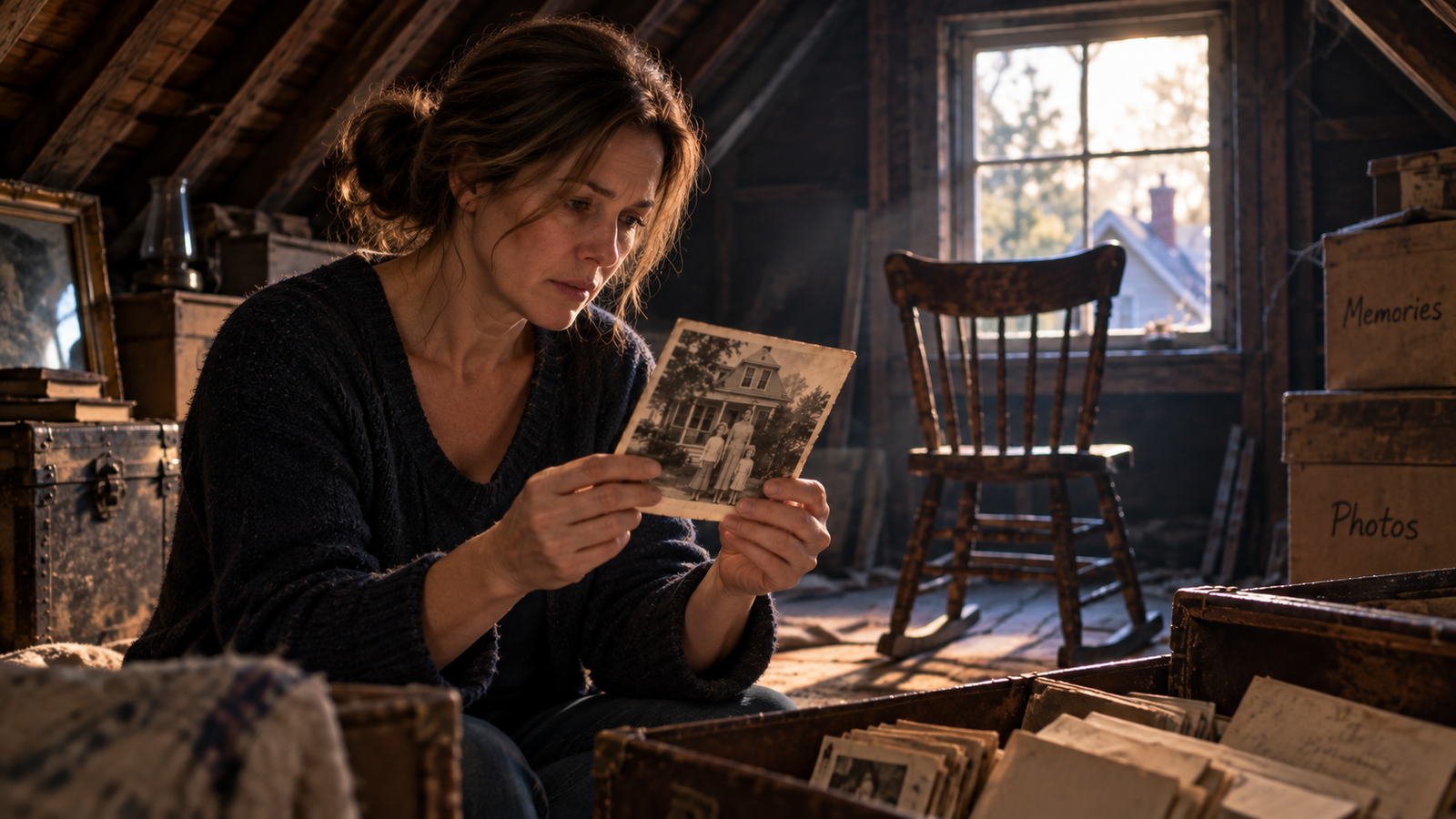
The first time my neighbor asked me to stop going into my attic at night, I thought he was joking. I had been living in the house for eleven days, and most of my furniture was still wrapped in moving blankets. The dining room contained fourteen boxes labeled KITCHEN because I’d apparently lost the ability to organize anything after my divorce, and I had already discovered that the upstairs bathroom faucet only stopped dripping if you turned the handle slightly to the left and threatened it.
So when an elderly man appeared beside my mailbox one Saturday morning and said, “You might want to stay out of the attic after midnight,” I assumed this was simply what happened when you bought a ninety-year-old house in a small town. Old houses came with questionable plumbing, temperamental windows, and neighbors who had collected enough history to turn every creaking floorboard into a story.
I smiled. “Is this the part where you tell me it’s haunted?”
He didn’t smile back.
“No.”
His name was Arthur Bell. He lived next door in a narrow brick house with green shutters and a porch so immaculate that even the rocking chair looked disciplined. He was seventy-eight, according to Mrs. Patel across the street, and had lived on Hawthorne Street longer than anyone else.
Arthur looked past me toward the small attic window at the top of my house. “Just don’t go up there late.”
“Why?”
His eyes stayed on the window. “Because the last woman who lived in that house heard things too.”
The smile disappeared from my face.
I hadn’t told him I’d heard anything.
The House on Hawthorne Street
I bought 18 Hawthorne Street because I wanted a house nobody associated with my old life. For seventeen years, I’d lived with my husband, Eric, in a four-bedroom colonial outside Philadelphia. We chose the countertops together, planted hydrangeas along the driveway together, and raised our daughter, Sophie, in rooms where every scratch on the floor had a story attached to it.
Then Sophie left for college.
Six months later, Eric sat at our breakfast table and announced that he had been “unhappy for a long time.” I eventually learned that a long time meant roughly eight months, and that he’d spent six of them sleeping with a woman from his accounting firm.
The divorce was finalized the following spring. Eric kept the colonial, and I kept enough money to begin again somewhere else.
At forty-six, starting over turned out to involve considerably more cardboard than I’d anticipated.
Hawthorne Street was two hours away, in a town called Bellweather with one grocery store, two churches, a diner called Millie’s, and a hardware store where the owner somehow knew my name before I’d introduced myself. The house itself was a faded blue Victorian built in 1934, with three bedrooms, original hardwood floors, a deep front porch, and an attic large enough that the real-estate agent called it “future living space.”
I called it storage.
At least, I did until my fourth night there.
I woke at 12:43 a.m. to the sound of something dragging across the floor above my bedroom. It wasn’t footsteps. Whatever made the noise sounded heavier than that.
Scrape.
Silence.
Then another scrape.
I lay beneath the covers and listened. The attic was directly above me, and I’d carried six boxes up there that afternoon—mostly Christmas decorations and things Sophie had left behind. There was nothing that should have been moving.
The scraping came again.
This is the point in the story where Sophie later told me any sensible woman would have called the police. But I’d spent seventeen years living with a man who could sleep through smoke alarms. I’d developed the unfortunate habit of investigating things myself.
I took my phone, switched on the flashlight, and pulled down the attic stairs.
The attic smelled of dry timber, dust, and insulation. My boxes sat exactly where I’d left them. I checked behind the chimney and along the far wall. The small window facing Arthur’s house was locked.
Nothing.
Then my flashlight passed across an old wooden chair near the far end of the room.
It faced the window.
I stood there trying to remember whether I’d seen it before.
I was almost certain I hadn’t.
The Photograph
In daylight, the chair seemed less frightening. Old furniture has a way of looking sinister at one in the morning and merely inconvenient at breakfast.
I convinced myself I’d overlooked it. The previous owner had left several things behind: a rusted garden rake, three empty paint cans, and a ceramic duck wearing a bonnet that I hadn’t yet found the courage to throw away. An old chair wasn’t impossible.
Then Arthur approached me beside the mailbox and told me to stay out of the attic after midnight.
I studied him. “You said the last woman heard things. What things?”
He pushed his hands into the pockets of his jacket. “Movement.”
“What kind of movement?”
“The same kind you’re hearing.”
A chill moved across my shoulders despite the warm September morning.
“How do you know what I’m hearing?”
Arthur’s expression changed—not surprise exactly, but regret. He had said more than he intended.
“I’ve lived next door a long time.”
“That doesn’t answer my question.”
“No,” he said quietly. “It doesn’t.”
“Who was the woman?”
He looked toward my house. “Her name was Margaret.”
“The previous owner?”
“No.”
“Then who?”
Arthur walked away without answering.
That afternoon, I decided to measure the attic. If I was going to live alone, I thought, perhaps turning it into a small office would make the house feel more deliberately mine and less like somewhere I’d landed after a divorce.
Behind the chimney, I noticed that one floorboard didn’t quite line up with the others. It was narrower and slightly darker. When I pressed it with my foot, it moved.
Underneath was a shallow compartment containing a yellowed envelope.
There was no letter inside.
Only a photograph.
Four people stood in front of my house—a man, a woman, and two little girls. The porch railing was white then, and the maple tree beside the driveway hadn’t yet been planted, but there was no mistaking the house.
On the back someone had written:
Hawthorne Street, August 1947.
The date itself wasn’t particularly strange. The house had already been thirteen years old.
The woman was.
I knew her face.
I’d seen it throughout my childhood in a silver frame on my mother’s bedroom dresser.
The woman standing in front of my house in 1947 was my grandmother Eleanor.
A Family I Didn’t Know
My mother, Helen Carter, had died twelve years earlier. She spent nearly her entire adult life in Pennsylvania—or at least that was what I’d always believed.
The photograph on her dresser showed Eleanor as a young woman beside a lake, wearing a white blouse with a small silver brooch pinned near the collar. Eleanor died before I was born, so everything I knew about her came from my mother’s occasional stories and that single photograph.
The woman standing on Hawthorne Street wore the same brooch.
I sat on the attic floor and stared at her.
My grandmother had once stood in front of the house I’d just bought.
Nobody in my family had ever mentioned Bellweather. Nobody had mentioned Hawthorne Street. I’d found the house through an online listing because I liked the porch.
At least, that was what I’d believed.
I called Sophie.
“Mom,” she said when she answered, “if this is about whether curtains are supposed to touch the floor, I already told you I don’t know.”
“Do you remember the photograph of Grandma Eleanor?”
“The one from Grandma’s dresser?”
“Yes.”
“Why?”
I sent her a picture of what I’d found.
She called back almost immediately.
“Mom, who’s the little girl?”
“There are two.”
“The younger one. On the right.”
I enlarged the photograph. One girl looked about eight. The other was perhaps five and stood partly behind Eleanor, gripping her skirt.
“What about her?”
“She looks like Grandma.”
For a moment, I didn’t understand.
Then I did.
Not Eleanor.
My mother.
Helen had been born in 1942.
In August 1947, she would have been five years old.
Exactly the age of the little girl in the photograph.
I didn’t call Arthur this time.
I went next door.
What Arthur Knew
Arthur opened his door before I knocked twice. I held up the photograph, and the color seemed to drain from his face.
“Where did you get that?”
“My attic.”
He stared at it for several seconds.
“Arthur, who are these people?”
“You know who some of them are.”
“How do you know that?”
He stepped backward and opened the door wider. “You should come inside.”
His living room looked like a museum curated by someone who distrusted change. There was a brown sofa, an old wooden television cabinet, crocheted covers on the arms of every chair, and a mantel crowded with photographs.
I remained standing.
“Who was Margaret?”
Arthur lowered himself into an armchair.
“My sister.”
“The woman you said lived in my house?”
“Yes.”
“When?”
“Until 1971.”
I put the photograph on the coffee table. “Did she know my grandmother?”
Arthur stared at his hands.
“They all lived there.”
I felt something shift inside me.
“My family?”
“Your grandmother. Your mother. Margaret. My parents. For a while, yes.”
“Why?”
“Because they were family.”
I frowned. “My grandmother’s maiden name was Wallace.”
“I know.”
“Your last name is Bell.”
“I know that too.”
“Then how were you family?”
Arthur looked toward the mantel. Near an old clock stood a black-and-white photograph of two teenage girls with their arms around each other.
One was Eleanor.
The other looked enough like her to be her sister.
“Margaret was Eleanor’s younger sister,” he said.
I had never known my grandmother had a sister.
Which meant Arthur wasn’t simply my strange elderly neighbor.
He was my mother’s cousin.
The Letters in the Wall
Arthur had known who I was from the day I moved in.
That realization made me angrier than I expected.
“You watched me carry boxes into that house knowing my mother grew up there, and you said nothing?”
“I didn’t know how much you knew.”
“I knew nothing.”
“I understand that now.”
“What happened here?”
Arthur’s face tightened.
“In 1956, something happened between Eleanor and your mother. Helen was fourteen. Three days later, they left Bellweather. They never came back to live here.”
“What happened?”
“There are things my mother told me and things I actually witnessed. At my age, I’ve learned not to confuse the two.”
“You warned me about noises in my attic, Arthur. This seems like a strange moment to become careful.”
That almost made him smile.
Almost.
“The attic is the part I know.”
“What happened there?”
“When we were children, Margaret told us never to go up there.”
“Why?”
“Because that’s where Eleanor kept the letters.”
“What letters?”
Arthur looked directly at me.
“The ones from your grandfather.”
“My grandfather was Charles Carter.”
“No.”
He said it gently.
“Charles Carter was the man Eleanor married afterward.”
That night, I didn’t sleep.
At 12:38, the scraping started again.
This time I climbed into the attic carrying my flashlight and a screwdriver. The chair was still beside the window.
I moved it aside.
Two parallel scratches marked the floor beneath its legs, as though someone had moved the chair backward and forward hundreds of times.
The marks led toward the wall.
I tapped the plaster.
Hollow.
Running my fingers along the baseboard, I found a tiny metal catch buried beneath several coats of paint.
It clicked beneath my thumb.
A narrow panel opened.
Inside the wall sat a brown leather suitcase.
It contained letters.
Dozens of them.
Some tied with faded string, others still inside envelopes. Every one was addressed to Eleanor Wallace.
Most came from a man named James Bennett.
The earliest was dated 1940.
The latest was dated November 1956.
I read until nearly four in the morning.
James wasn’t simply someone my grandmother had known.
He was the man she’d planned to marry.
Then war changed everything.
The Man Who Came Back
James had gone overseas believing he would return and marry Eleanor. While he was gone, she discovered she was pregnant.
My mother.
His family apparently disapproved of Eleanor. Her parents had little money, while the Bennetts owned property around Bellweather. The letters hinted at arguments, pressure, and promises James believed he could keep once he returned.
Then he was reported missing.
Eleanor believed he was dead.
She raised Helen alone for several years before eventually marrying Charles Carter, the man my mother would grow up calling Dad.
But James Bennett hadn’t died.
He’d been badly wounded.
When he eventually returned to the United States, he began writing to Eleanor.
The letters continued for sixteen years.
The early ones were gentle. Later, they became desperate.
James wanted to meet his daughter.
Eleanor refused.
Helen had a father now. She had a home. Eleanor had built a life out of whatever pieces remained after the war, and she apparently believed introducing James would destroy more than it repaired.
Then I found the final letter.
It wasn’t from James.
It was from my mother.
Fourteen-year-old Helen had discovered the correspondence.
Her handwriting was careful and almost painfully neat.
I know who you are.
She’d written to James without Eleanor knowing.
She wanted to meet him.
They arranged to meet at the Bellweather train station.
But Eleanor discovered their plan.
An argument followed.
Helen packed a suitcase.
Three days later, mother and daughter left Hawthorne Street permanently.
The Chair
By morning, I understood most of what had happened.
I still didn’t understand the chair.
Arthur came over after I called him, and together we climbed into the attic. He stopped when he saw it.
“That’s strange.”
“What?”
“That wasn’t Margaret’s chair.”
I stared at him. “You told me she used to come up here.”
“She did. But her chair was downstairs when she died.”
“Then whose is this?”
Arthur turned it over.
Beneath the wooden seat, almost invisible beneath decades of dust, someone had carved a date.
1956.
Beside it were two initials:
H.C.
Helen Carter.
My mother.
Arthur lowered himself slowly onto the attic floor.
“I didn’t know.”
“Knew what?”
“That she came back.”
The chair had been manufactured in 1956, but my mother didn’t become Helen Carter until years later. Those initials must have been added after her marriage.
At some point after leaving Bellweather, my mother had returned to this attic.
We searched the suitcase again.
Arthur eventually noticed a small tear in the lining.
Behind it was one final envelope.
It had never been mailed.
For Margaret.
The letter was dated 1982.
My mother had been forty.
I was four.
Helen wrote that she’d returned to Hawthorne Street during a trip through Pennsylvania. She’d parked several streets away and walked past the house twice before finding the courage to enter.
She couldn’t bring herself to knock on Margaret’s door afterward.
Instead, she’d spent almost an hour sitting in the attic.
She wrote about my father.
About me.
About the life she’d built.
Then I reached a paragraph that made me stop.
I spent years believing my mother ruined my life by keeping the truth from me. It took becoming a mother to understand that sometimes people hide things because they’re afraid the truth will hurt their children more than the lie. I understand her now. I just wish understanding had come while she was still alive.
I read it again.
Then I handed the letter to Arthur.
For several minutes, neither of us spoke.
What Was Moving After Midnight
The explanation for the noises turned out to be disappointingly ordinary.
One leg of the old chair was slightly shorter than the others. Freight trains passed outside Bellweather most nights around twelve forty. The vibration traveled through the old timber frame of the house and shifted the chair a fraction of an inch.
Scrape.
Pause.
Scrape.
There was no ghost wandering through my attic.
No dead woman returning after midnight.
Just an uneven chair, an old railway line, and a house full of things nobody had explained.
I wasn’t disappointed.
Real families had always frightened me more than ghosts.
Arthur and I spent the next several weeks going through the letters. He had photographs I’d never seen, and I had stories he’d never heard. Between us, we reconstructed pieces of people who’d spent most of their lives trying not to discuss one another.
One Sunday afternoon, Arthur arrived carrying an envelope.
Inside was a photograph of my mother at fourteen.
She sat on the front steps of my house, her hair pulled into a ponytail and her arms crossed over her knees. Her expression was stubborn.
I knew that expression.
I’d seen it on Sophie.
I’d seen it in mirrors.
On the back Margaret had written:
Helen. Two weeks before she left.
I framed the photograph.
It hangs in my hallway now.
The Things Houses Keep
Six months after I moved to Hawthorne Street, Sophie came home for spring break and found me in the attic sorting the last of the letters.
“You’re still up here?”
“Apparently our family generated a lot of paperwork.”
She sat beside me and noticed the chair.
“Is that the haunted one?”
“Allegedly.”
“You’re keeping it?”
“Yes.”
“Why?”
I looked toward the little attic window. Across the narrow space between the houses, Arthur was outside trimming something in his garden.
My mother had once sat in that chair and looked through the same window at a street she’d spent years trying to escape.
Forty-four years later, I’d bought the same house while escaping a life of my own.
Maybe that was coincidence.
Probably it was.
But not every coincidence needs to be explained to matter.
“Because it belongs here,” I said.
Sophie rested her head against my shoulder.
We stayed there until the attic began to darken.
I still hear the chair sometimes.
Usually around twelve forty, when the freight train passes outside town.
Scrape.
Silence.
Scrape.
I don’t get out of bed anymore.
The sound doesn’t frighten me.
It reminds me that houses don’t really keep secrets.
People do.
We put letters behind walls and photographs beneath floorboards. We remove names from stories. We decide which truths our children are old enough to hear and then sometimes wait so long that we lose the chance to tell them ourselves.
My grandmother thought silence would protect my mother.
My mother spent years believing that silence had betrayed her.
Then she became a mother herself and discovered that love can make frightened people do complicated things.
I spent forty-six years believing her story began in Pennsylvania.
Then I bought an old blue house because I liked the porch.
And discovered she’d been there before me.
Long before I was born.
Long before she knew what kind of woman I would become.
Sometimes I wonder what she would say if she could see me living here now.
I think she’d laugh first.
Then she’d probably point out something in the house that needed fixing.
And after that, maybe she’d look at me the way she always did when I finally figured something out for myself.
As if she’d known the answer all along.
As if she’d simply been waiting for me to get there.