
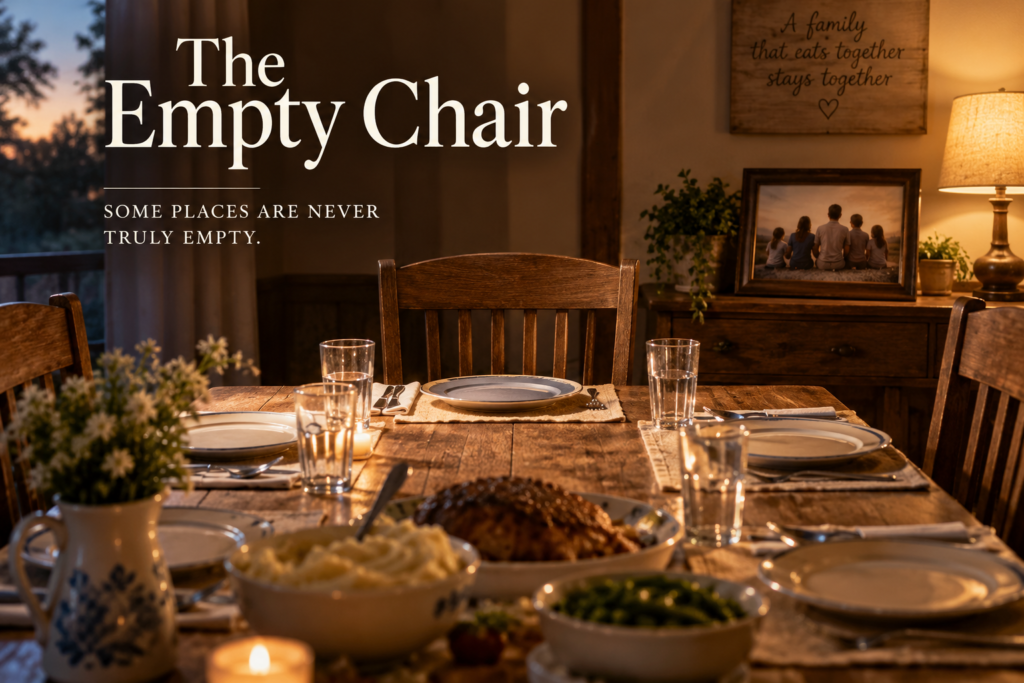
The Rule
Every night at six o’clock, Tom Whitfield set five places at the oak table.
Two forks, two knives, two glasses of water for the two people who actually lived in the house. Then three more, laid out just as carefully, for the three who didn’t.
Margaret watched him from the stove, a dish towel over her shoulder. She had watched him do it for eleven years, and she had never once said a word.
Tonight, for reasons she couldn’t name, she almost did.
“Tom,” she said.
“Hm?”
She looked at the plate in front of Jake’s old chair, the blue one with the chip near the rim. Then she shook her head and turned back to the pot roast. “Nothing. It’s almost ready.”
It had been Margaret’s rule, back when she was a young mother with three kids under ten and flour up to her elbows.
Every night. No exceptions.
“A family that stops eating together,” she used to say, “stops being a family, even if they’re still living under the same roof.”
Tom teased her about it at first. He was a hardware store man, practical to the bone. He thought rules like that were for other people’s families, the kind with time for them. But somewhere between the first scraped knee and the third birthday cake, he became the rule’s fiercest defender.
For eighteen years, they kept it. Rain or shine. Exam week. Harvest season on Grandpa Whitfield’s old farm. The five of them crowded around the table the old man had built with his own hands, elbows knocking, everyone talking at once, and nobody allowed to leave until the last plate was clean.
Jake, the eldest, always sat at Tom’s right hand, the heir apparent. Claire, the middle child, sat across from him, arguing about everything. Sarah, the baby, sat closest to her mother and slipped her carrots under the table to the dog.
It was loud. It was messy. It was, though none of them would have said so, the happiest place on earth.
The cracks came slowly, the way water finds its way into a foundation.
The first one was money.
Tom had run Whitfield Hardware for twenty years, and for nineteen of them it had been a good business. Then the big chain store opened out by the highway, and the numbers began to slide. Tom watched them slide. He told no one.
He took out a loan against the store. Then a second one, against the house.
Margaret found the paperwork on a Tuesday in March, in the bottom drawer of his desk, under a stack of supplier catalogs.
She didn’t shout. That was the worst part. She laid the papers on the kitchen counter and said, very quietly, “How long?”
“Margaret—”
“How long have you been lying to me?”
“I wasn’t lying, I was protecting—”
“That’s what a lie is, Tom. It’s when you decide what I’m strong enough to know.” She picked up the papers and set them down again, as if they were something that might burn her. “I thought we told each other everything. I thought that was the whole point of us.”
“And I thought,” Tom said, his voice going hard, the way it did when his pride was bleeding, “that after twenty-six years you’d have a little respect for how much I’ve carried.”
The words hung in the kitchen like smoke.
Neither of them saw Jake standing in the doorway with his car keys in his hand.
He was twenty-four. He had come home that night to tell them something good.
Instead he stood there and heard his parents tear each other open over a stack of paper, and something in him that had held for twenty-four years quietly gave way.
“I got the job,” he said.
They both turned.
“In Denver. The engineering firm. I signed the offer yesterday.” He looked at his father, and there was something new in his face, something Tom didn’t recognize and didn’t like. “I was going to ask what you thought. But I guess you two have plenty to talk about.”
“Jake,” Margaret said. “Honey, it’s not what it sounds like—”
“Denver’s a long way,” Tom said. He said it flat, with no warmth, the way a man speaks when he’s afraid and can’t afford to look it. “If you wanted to leave, you could’ve at least had the decency to say so to my face.”
“I am saying it to your face, Dad.”
“Then go.”
The silence that followed was the loudest sound the Whitfield kitchen had ever heard.
Jake nodded slowly. Set his keys on the counter. Picked them up again.
“Fine,” he said. “I’m not hungry anyway.”
The front door closed behind him, not slammed, which somehow made it worse.
Margaret looked at the table, already set for dinner, five plates waiting. Jake’s blue plate sat by itself at Tom’s right hand.
That was the first night in eighteen years that one of them left the table before the meal began.
It would not be the last.
Margaret looked at her husband. He had heard every word.
“Tell her yes,” he said, and his voice was rough. “Tell her yes.”
But there was still Jake. And Claire. And a hundred small silences between them that no phone call could undo.
And Margaret didn’t know yet that Jake had already been trying to reach them.
PART 2 — Three Empty Chairs
Claire left next, and she left angrily, which made it easier for everyone to pretend it was about something else.
She was twenty-two, finishing her last year of teaching school, and she had met a man named Daniel at a friend’s wedding. He was a carpenter, quiet and kind, with sawdust always somewhere on him. Claire brought him home for dinner in October.
Tom shook his hand, said all the right things, and sat through the meal with his jaw locked.
Afterward, on the porch, Claire said, “You hated him.”
“I didn’t say that.”
“You didn’t have to. What is it? He doesn’t have a degree? He doesn’t own a house?” She crossed her arms. “He’s good to me, Dad.”
“I didn’t say he wasn’t.”
“Then say what you did mean.”
Tom opened his mouth. Nothing came out. Because the truth was too small and too shameful to say aloud: Daniel reminded him of himself at twenty-five, with big hands and no safety net, and Tom knew exactly how a man like that could fail the people who depended on him. He had just spent a year proving it.
He never said it. And Claire never forgave him for not saying it.
She married Daniel at the courthouse the following spring. Tom learned about it from a card in the mail.
Sarah, the baby, held on the longest.
She was the peacemaker, the one who called both sides, who carried messages between people who weren’t speaking. For two years, she was the bridge that the rest of the family walked across in the dark without ever meeting in the middle.
Then she went off to college in Oregon. The visits home got shorter. The phone calls became once a week, then twice a month, then holidays only, and finally not even that.
“It’s exhausting,” she told her mother once, near the end. “Being the only one who’s still willing to try.”
Margaret didn’t have an answer for that. She was too busy learning how to be a person who had failed her own rule.
So there they were, the two of them.
The oak table, which had once been too small for five people and their elbows, now stretched between them like a field. Margaret’s cooking, once measured in triple batches, shrank to a single pan. The house grew quiet in ways it had never been quiet before.
The dinner hour, which had been the loudest of the day, became the hardest.
But they kept the rule.
That was what nobody understood about it, later. They didn’t keep it out of stubbornness, though there was plenty of that. They kept it because it was the last thing they had that belonged to all five of them. As long as the table was set, the family still existed in some small, stubborn way.
Tom saved the store, eventually. It took six hard years and a lot of humility, and he never forgave himself for the cost. Margaret found the strength to go back to school and finish the nursing degree she’d put aside when the children came.
They did not talk about the loan. They did not talk about Jake, or Claire, or Sarah.
They just set the table.
“You still think he’s walking through that door tonight?” Margaret asked once, on a rainy November evening in the ninth year, watching her husband spoon mashed potatoes onto an empty plate.
“No,” Tom said.
“Then why do you keep—”
“Because if I stop setting it,” he said, still not looking at her, “it means I’ve given up on him. And I’m not ready to do that. Not yet.”
Margaret didn’t answer.
She stood there a long moment. Then she walked to the cupboard, took down a plate, and set it at Claire’s old place.
It was the first time she’d done it. Tom looked up, and for one moment, something passed between them that hadn’t in years.
He didn’t say anything. He just nodded.
That night, for the first time in nine years, they ate dinner and talked: about the kids, and the house, and who they’d been before all of it. It was awkward. It was slow. But it was a start.
The phone rang on a Sunday in April.
Margaret almost didn’t answer it. She was elbow-deep in bread dough and it was probably a telemarketer. But something made her wipe her hands and pick it up.
“Mom?”
She knew the voice at once, though she hadn’t heard it in over a year. It was thinner now, wet and shaking.
“Sarah? Sweetheart, what’s wrong? Are you—”
“I’m fine. I’m okay. I just…” A ragged breath. “I had the baby, Mom. In March. A little girl. I named her Rose.”
Margaret sat down hard on the kitchen chair. Her hand flew to her mouth.
“She’s asked me something,” Sarah went on. “Last week. She’s only a year old, I know, she can’t really ask, but there was a family at the park, grandparents and grandkids, and she just reached out toward them, and I—” Her voice cracked completely. “I realized she’s never going to know you. Or Dad. And I couldn’t even remember why.”
“Sarah—”
“I don’t even remember what we were so angry about,” Sarah whispered. “I remember being furious. I just don’t remember at who, anymore.”
Margaret pressed her hand flat against the table, feeling the grain of the old oak beneath her palm. Across the kitchen, Tom had come in from the garage and was standing very still.
“Mom,” Sarah said, “can I come home?”
Margaret looked at her husband. He had heard every word.
“Tell her yes,” he said, and his voice was rough. “Tell her yes.”
But there was still Jake. And Claire. And a hundred small silences between them that no phone call could undo.
And Margaret didn’t know yet that Jake had already been trying to reach them.
PART 3 — The Table
Sarah came home on a Friday, with a diaper bag, a tired smile, and a baby on her hip who stared at Tom as if he were the most fascinating thing she had ever seen.
Tom had rehearsed a speech for three days. When the moment came, he took the child in his arms and forgot every word.
“Hello, Rose,” he managed. “I’m your grandfather. I’m sorry I’m so late.”
Sarah cried. Margaret cried. Tom, who hadn’t cried in front of anyone since his own father’s funeral, discovered that his face was wet and simply let it be.
It was Sarah who made the calls after that. She was good at it. She had always been the bridge.
But Jake, it turned out, hadn’t needed calling.
“He’s called the store,” Tom said that night, in the kitchen, after the baby was asleep. He said it carefully, the way a man handles glass. “Three times, over the years. I never picked up. Cindy at the front desk kept telling me, and I kept saying, ‘Take a message.’ I was afraid if I heard his voice, I’d say the wrong thing again.”
“Tom.” Margaret stared at him. “Three times?”
“I know.”
“Do you know what it would have meant to him just to hear—”
“I know, Margaret.” He rubbed his eyes. “I know.”
She was angry. She was allowed to be. But she looked at her husband, who was sixty years old and shaking, who had spent eleven years setting a plate for a son he was too proud to call, and she felt her anger fold into something gentler.
“Then call him back,” she said. “Right now. Before you lose your nerve.”
Tom took out the old address book, the paper one with the cracked spine. His hands weren’t steady on the phone. It rang four times.
“Hello?”
“Jake,” Tom said.
There was a silence so long that Margaret thought the line had gone dead.
“Dad?” Jake’s voice came very small across a thousand miles. “Is that you?”
“It’s me, son.” Tom closed his eyes. “I’m sorry. I should have said it a long time ago. I’m just… I’m so sorry.”
They came in June.
Jake arrived first, gray now at the temples, with a wife nobody had ever met and a small, nervous wave from the driver’s seat. Her name was Priya. She held a casserole dish in both hands, as if it were a peace treaty.
Claire came two days later, alone. Her marriage had not lasted, though she said so lightly, with a shrug that fooled nobody. But when she saw the old house, her laugh broke loose. It was exactly the same laugh she’d had at seventeen, and Margaret had to turn away to hide her face.
They stood in the front hall, all five of them, unsure what to do with their hands.
Then Margaret said, in the brisk voice she’d used to herd three children into cars for eighteen years: “Well, don’t just stand there. Dinner’s at six.”
The table looked the same.
That was the strangest part, the way the room had held itself perfectly still while everything else changed. Grandpa Whitfield’s oak, with its old scratches and water rings, ready as ever.
Tom pulled out the extra leaf, the one that had been stored under the stairs for over a decade, and slid it into the middle. It fit with a soft wooden thunk, and the table stretched to its full length.
“Never thought I’d see that come out again,” he said quietly.
Sarah reached under the table to steady the leaf, then stopped. “Dad. There’s something carved down here.”
She ducked lower. The others crowded close.
Carved into the underside of the oak, worn nearly smooth by decades of small knees and swinging feet, were six words in an old man’s careful hand:
ALWAYS ROOM FOR ONE MORE.
Nobody said anything. Tom pressed his fingers to the letters, and his whole face changed.
“Dad made this table,” he said finally, “for a family that would grow. He built it big on purpose. I never understood why, until…”
He didn’t finish. He didn’t have to.
Baby Rose was the one who chose her seat.
She wriggled out of her mother’s arms and toddled straight toward Jake’s old chair, the one that had waited empty, plate and all, for over a decade. She grabbed the edge and hauled herself up onto the cushion with enormous dignity.
“Oh, sweetie,” Margaret began, out of old habit. “That’s not your—”
Tom put a hand on her arm.
“Let her have it,” he said quietly. “It’s been empty long enough.”
Jake, standing at his father’s right side, looked down at the tiny girl in his old seat, and then up at Tom. Something passed between them, a whole conversation with no words, eleven years of it, unspooling all at once.
“Move over, Dad,” Jake said, his voice not quite steady. “I think I’ll sit by Claire.”
Nobody made a speech that night.
There was no great reconciliation, no single sentence that undid eleven years of silence. There was pot roast, and mashed potatoes, and the particular sound of a family remembering how to pass dishes hand to hand, the way they used to when none of them had to think about it.
Tom spooned potatoes onto five plates without a moment’s hesitation. Then, after a beat, a sixth for Priya. Then, with a wink at the toddler in the high chair, a tiny seventh.
They had come back. Not whole, not unchanged, carrying scars that would ache on certain nights for the rest of their lives.
But back.
Later, when the dishes were done and the house had finally gone quiet, Margaret found the old blue plate, the chipped one Tom had set at Jake’s empty seat for eleven years, worn smooth from being set down and picked up by a man who wouldn’t stop hoping.
She didn’t put it back in the cupboard.
She washed it, dried it, and stood it on the mantel where everyone could see.
Above it, in the firelight, the family photograph hung a little crooked, the way it always had. She reached up to straighten it, then thought better of it.
Some things, she decided, were perfect exactly the way they were.
THE END